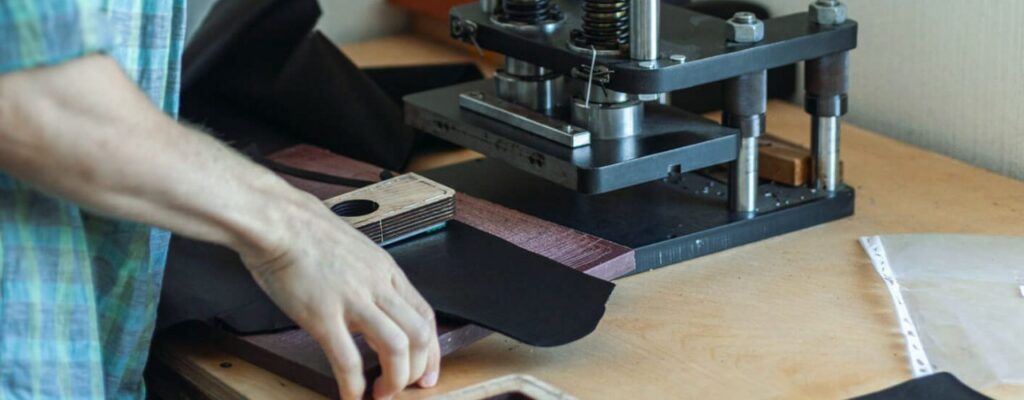
High-end design relies on finishes that last. When you look at premium leather goods the permanence of the brand mark confirms the product’s quality. For the deepest, most permanent impression in leather foil stamping, the production process demands absolute precision for the final mark.
Most professionals understand the basic variables: heat, pressure, and dwell time. However, the true difference between a superior finish and an unacceptable one lies in the make-ready. This precision preparation ensures the die meets the hide surface with absolute, uniform force across the entire face, which achieves the designer’s goal: transforming a logo into an enduring mark of quality.
Successful leather foil stamping demands mechanical precision and an understanding of how different leathers respond to thermal transfer and pressure mechanics. A hot foil press alone does not suffice. This blend of engineering and material knowledge shows why a hand-built press, like those from Metallic Elephant, offers clear production value.
The Significance of Make-Ready for a Premium Finish
In printing, the make-ready compensates for minor differences in the material. For uniform paper or card stock, this is a relatively simple adjustment.
Leather foil stamping presents a challenge that is entirely unique. Leather is an organic material with natural variations in density, temper, and thickness (caliper) across a single hide. The material itself acts as an uneven, yielding surface, making the make-ready job far more demanding than working with uniform substrates.
The make-ready for leather means tactical preparation. You use rigid support materials placed on the platen (the press bed) to establish guaranteed platen parallelism, which simply means the die and the leather are perfectly level when they meet. This focused, rigid support prevents the die impression from drawing or stretching the delicate hide. Because the deboss physically anchors the foil’s adhesive layer into the leather fibre, the resulting mark is truly permanent.
An experienced operator must use a hard counter-board to prevent the impression from stressing the material. Without this firm, controlled support, the leather will distort, resulting in a fractured mark, surface scoring, and premature foil failure.
Navigating Different Hides: Settings by Leather Type
Its tanning process categorises leather, and each type dictates a distinct approach to leather foil stamping. Settings that create a perfect mark on one hide type can instantly burn or scuff the surface of another, turning luxury material into waste.
Why Vegetable-Tanned Leather Needs Less Heat
Vegetable-tanned leather (veg-tan) is dense, firm, and accepts a clean, deep deboss easily due to its rigid internal fibre structure. This density also makes it highly efficient at conducting heat.
- Actionable Advice: High heat can quickly scorch or permanently discolour the edges of the impression on veg-tan. To preserve the material’s integrity, use lower heat settings combined with a slightly longer dwell time. This ensures the foil’s adhesive layer has enough time to fully transfer without causing thermal degradation to the surrounding hide.
Chrome-Tanned Leather: Controlling the Rebound
Chrome-tanned leather presents a different mechanical challenge. It is typically softer, thinner, and highly pliable. This high pliability means it is prone to “memory rebound,” where the impression quickly loses depth as the material tension relaxes after the die lifts.
- Actionable Advice: This type of leather foil stamping requires higher pressure, precise heat control, and a very firm, minimal make-ready to counteract the material’s elasticity. You must quickly and definitively compress the fibres before they can spring back. Vitally, the press must provide outstanding mechanical stability to deliver perpendicular pressure. This prevents the head from twisting or shifting, a movement that would instantly scuff and ruin the soft chrome-tanned surface.
Precision Placement: Designing and Using Jigs
Precision becomes exponentially more difficult when applying a mark to a pre-stitched product, a finished accessory, or any item with complex geometry. A standard fence or corner guide is rarely enough for repeatable, high-volume production alignment.
When a Standard Fence is Not Enough
For guaranteed, repeatable results on long production runs such as branding hundreds of identical wallets or journals you need non-slip positioning that eliminates the risk of human error.
- Actionable Advice: The definitive solution is the use of bespoke presses. Our engineers typically design these to hold the leather item in the exact same spot for every impression. The jig not only guides the placement but ensures the printing area is perfectly presented to the die, guaranteeing consistent alignment across high-volume professional runs and automating placement for a clean hand-off between products.
Perfecting the Monogram on Curved Items
Applying a monogram or logo to a curved item, such as a rounded notebook spine or the edge of a phone case, requires a unique mechanical setup that confirms technical skill.
To achieve successful leather foil stamping on non-flat goods, operators must adapt the make-ready. This involves creating a custom support structure often a precisely contoured make-ready within the custom jig itself. This structure supports only the exact contact area, focusing all the machine’s pressure directly beneath the die face and preventing the surrounding leather from collapsing or deforming.
- Active Tip: Always check the press’s throat depth and clearance to ensure the entire jig and the leather item can be placed without the press frame obstructing the placement or the operator’s view.
Press Stability: Why UK-Built Presses Guarantee Your Brand’s Reputation
The high standards of leather finishing directly relate to the press used. When you demand the precision required for a flawless leather foil stamping mark even on tricky chrome-tanned hides or curved items the machine’s mechanical stability is critical for reducing waste and ensuring maximum yield.
What Makes a UK-Built Press Different?
Machines built with uncompromising mechanical integrity consistently meet the complex make-ready and pressure requirements necessary for leather. Metallic Elephant builds presses by hand to order in the UK; this guarantees the machine geometry, ensuring the platen and the machine head are perfectly parallel across the full surface area of the press.
This guaranteed mechanical stability allows the press to deliver even pressure across the entire die face, regardless of size or complexity. You need this level of precision for two critical outcomes:
- Uniformity: Every point of the die face must deliver the same heat and pressure to ensure the foil bonds consistently and cleanly across the whole mark. A clean mark is a professional mark.
- Longevity & Stock Safety (The Engineering): Uneven pressure causes the die to stress the weakest parts of the leather, leading to stretched fibres and damaged goods. Mass-produced presses often struggle with head parallelism, and that uneven alignment instantly ruins delicate leather by applying too much force to one side of the die.
Achieving a Lasting, Premium Finish
High-quality leather foil stamping requires mechanical discipline and deep material knowledge. General technique plays a smaller role. The process demands that the press delivers absolute, repeatable precision, especially when working with varied hides and complex placements on finished goods.
The truth is final mark demands expert engineering. Connect with our UK engineers now to discuss machine stability, specific tooling requirements, or a custom jig design. We help you achieve flawless results every time.

Written by Metallic Elephant