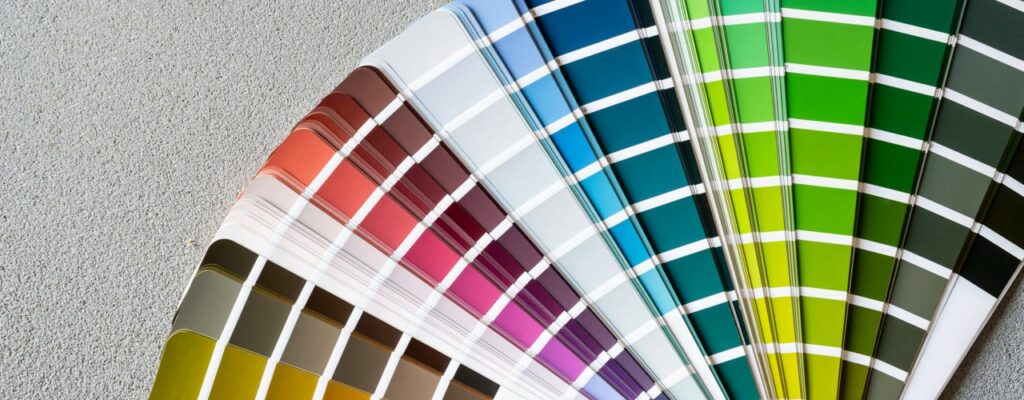
For an additional fee, we offer a choice of colour on our presses. To create this for you, we will ask for a RAL colour. As our industry sits closer to manufacturing than traditional graphic design, this can sometimes raise questions, especially if you’re more familiar with Pantone colours.
If you work in graphic design or print, you might be wondering:
“Why RAL? I only know Pantone!”
Let’s break it down in a simple, practical way, and look at how this also applies to real-world processes like foil printing.
What Is the RAL Colour System?
The RAL colour system was developed in Germany in 1927 and is widely used in industrial sectors. Think paints, powder coatings, manufacturing, construction, and signage.
If something needs to be painted consistently across metal, plastic, or coated surfaces, RAL is often the go-to system.
Why industries rely on RAL
• Designed specifically for paints and coatings
• Standardised four-digit coding system
• Reliable and consistent across materials
• Around 2,500 colours available
While 2,500 colours might sound limited, it is more than enough for industrial applications where durability and uniformity matter more than subtle tonal variation. RAL is built for function, consistency, and repeatability across physical surfaces.
For machinery, equipment, and coated components, this level of consistency is far more important than having thousands of near-identical shades.
What Is the Pantone Colour System?
The Pantone Matching System, developed in the 1960s, is one of the most recognised colour systems in the world, especially in creative industries.
If you have worked in branding, graphic design, fashion, or print, chances are you have used Pantone.
Why creatives rely on Pantone
• Over 10,000 colours
• Designed for print, packaging, textiles, and digital media
• Extremely precise colour matching
• Ideal for brand consistency
Pantone ensures your brand colour looks consistent across different formats, whether that is a website, printed brochure, packaging, or fabric. That level of precision is essential when maintaining a strong and recognisable brand identity.
This is particularly important in processes such as foil printing, where colour accuracy and finish play a major role in the final result. Pantone matching allows designers and printers to work towards a consistent visual outcome, even across different materials.
There are even suppliers offering Pantone-matched hot stamping foils. However, these often require committing to large quantities, which may not be practical for smaller production runs.
How Colour Systems Impact Foil Printing
When working on projects that involve foil printing, the choice between RAL and Pantone becomes more than just preference, it becomes a practical decision.
Foil printing relies on transferring a metallic or pigmented foil onto a surface using heat and pressure. Because of this, colour behaviour differs slightly compared to standard ink-based printing.
Pantone is often preferred in foil printing because:
- It provides a wider range of colour references
- It allows for closer alignment with branding requirements
- It supports more precise colour communication between designer and printer
However, when foil is applied to coated or painted surfaces, especially in industrial applications, RAL may still be relevant for the base material colour.
Understanding how these systems interact ensures better results, fewer revisions, and a smoother production process.
Key Differences at a Glance
Range of Colours
RAL offers around 2,500 colours, making it ideal for industrial durability and coated surfaces.
Pantone offers over 10,000 shades, making it far more suitable for creative work and detailed colour matching, particularly in foil printing and other specialist print processes.
Precision and Application
RAL is simple and standardised, built for large-scale manufacturing where slight variation is acceptable.
Pantone is highly precise, offering subtle variations that are critical for brand accuracy and detailed print work.
When Should You Choose RAL?
Choose RAL if your project involves:
• Painted or powder-coated surfaces
• Metal, machinery, signage, or industrial equipment
• Long-term durability and consistent surface finish
For custom-coloured presses and coated components, RAL is the correct and industry-appropriate system. It ensures that your equipment looks consistent and performs reliably over time.
When Should You Choose Pantone?
Choose Pantone if your project involves:
• Print, packaging, textiles, or digital design
• Brand colour accuracy across multiple materials
• Processes like foil printing or detailed finishing work
Pantone is the standard for designers and printers who need precise, repeatable colour results. In foil printing, this level of control helps achieve a consistent and professional finish.
So… Which One Should You Use?
It really comes down to what you are colouring.
If it is ink on paper, branding materials, or foil printing applications, Pantone is the better choice.
If it is paint on metal, coated machinery, or industrial components, RAL is the correct system.
Understanding the difference helps you make the right decision from the start, saving time, cost, and potential rework further down the line.
Frequently Asked Questions
What is the difference between RAL and Pantone?
RAL is designed for paints and coatings used in industrial applications, while Pantone is designed for print and design work. Pantone offers greater precision, which makes it more suitable for branding and foil printing.
Is Pantone used in foil printing?
Yes, Pantone is commonly used in foil printing to guide colour selection and ensure consistency with branding. While the final foil finish may vary slightly, Pantone provides a reliable reference point.
Can RAL colours be used in print?
RAL colours are not typically used in print design. They are intended for physical coatings rather than ink-based processes. For print and foil printing, Pantone is the preferred system.
Why is colour accuracy important in foil printing?
In foil printing, colour and finish are key to the final appearance. Accurate colour selection ensures consistency across materials and helps maintain brand identity, especially in premium or high-visibility applications.
Can you match foil colours exactly to Pantone?
Foil colours can be matched closely to Pantone references, but exact matches are not always possible due to the reflective and metallic nature of foil. However, Pantone still provides the best starting point for achieving consistent results.
Which colour system is better for branding?
Pantone is generally better for branding because it offers a wider range of colours and greater precision. This makes it easier to maintain consistency across print, digital, and foil printing applications.

Written by Metallic Elephant