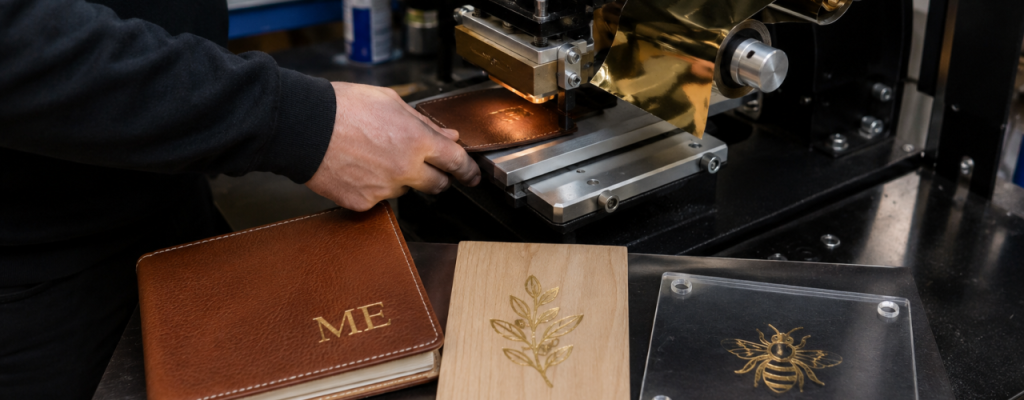
At Metallic Elephant, we’ve spent years perfecting the art of the foil press. While paper and cardstock remain the traditional canvas for hot foiling, the real magic happens when you push the boundaries.
There is something undeniably premium about the way light catches a metallic sheen against the grain of natural wood or the texture of high-quality leather. But let’s be honest: moving away from paper brings a new set of variables.
If you’re looking to expand your bespoke services or experiment with tactile materials, this guide is for you. Here’s how to master the art of foiling on the “challenging” trio: Leather, Wood, and Plastics.
1. Leather: The Art of Texture and Temperature
Leather is perhaps the most rewarding material to foil, but it is notoriously fickle. Because leather is an organic material, it varies in density, tanning process, and moisture content.
The Temperature Sweet Spot: Leather burns easily. You need lower temperatures than you would use for paper. If the foil isn’t adhering, don’t immediately crank the heat; try increasing the “dwell time” (the amount of time the die is in contact with the material) instead.
The Right Foil: Always use a foil specifically formulated for leather. These foils are designed to be more flexible, preventing the metallic layer from cracking when the leather is bent or flexed.
A Solid Foundation: You need a firm, non-resilient surface underneath your leather. If your bed is too soft, the pressure won’t transfer cleanly, leading to blurred edges.
2. Wood: Taming the Grain
Foiling on wood creates a gorgeous, rustic-meets-luxurious aesthetic. However, wood is porous and textured, which creates a natural resistance to a sharp, crisp imprint.
Surface Preparation: The smoothness of your wood is 90% of the battle. If you’re foiling onto raw timber, ensure it is sanded to a high grit. Any stray fibres will catch the foil and create a “fuzzy” or ghosted edge.
Sealing is Key: If you’re foiling onto porous wood, the foil adhesive can soak into the grain before it sets. A light coat of sanding sealer or a very thin primer can provide a smooth, non-porous surface that allows the foil to “sit” perfectly.
Pressure is Your Friend: Wood is hard. Unlike paper, it won’t compress easily. You will likely need more pressure than you’re used to, and a slightly longer dwell time to ensure the adhesive penetrates the surface topography.
3. Plastics: The Chemistry Challenge
Foiling onto plastic (think acrylics, PVC, or polypropylene) is entirely different because plastic is non-porous. You aren’t looking for absorption; you’re looking for a chemical bond between the foil adhesive and the plastic surface.
Dyne Levels Matter: Plastics have different surface energies (Dyne levels). Some plastics are naturally “low energy,” meaning nothing wants to stick to them. If you’re struggling, you may need a specialized plastic-bonding foil.
Temperature Control: Plastics are heat sensitive. Too much heat and you’ll melt or warp the substrate. Start at a low temperature and edge your way up in small increments until you find the exact point where the adhesive releases from the carrier film without damaging the plastic.
Cleanliness: Static is the enemy of plastic. Any dust or oils (even fingerprints) will act as a barrier between the foil and the material. Wipe your plastics down with an anti-static cloth or a mild solvent before you begin.
The Metallic Elephant Advantage
Whether you are a professional finisher or a boutique creator, the equipment you use determines your success with these materials. Achieving the perfect finish on challenging surfaces requires precision temperature control and consistent pressure, two things our machines are engineered to provide.
Pro-Tip: Always keep a “test scrap” pile. Before you run your final product, perform a “test strip” on a remnant of your exact material. Adjust your temperature, pressure, and dwell time until you get that flawless, mirror-like finish.
Are you working on an ambitious project that requires a custom die or expert advice on material compatibility? Get in touch with the team at Metallic Elephant today, we love a challenge.

Written by Metallic Elephant